
Gibson County Trial Courts
Indiana's court system has appellate courts and trial courts. The appellate level includes the Supreme Court of Indiana, Court of Appeals of Indiana, and Indiana Tax Court. Trial courts include circuit courts, superior courts, and local city or town courts where created. Gibson County's county-level trial courts are Gibson Circuit Court and Gibson Superior Court, with the Clerk of the Circuit Court serving as the unified clerk for filings, payments, copies, and record custody.
The official Gibson Circuit Court page lists the courthouse location, judge, court reporters, bailiff, phone, and fax.
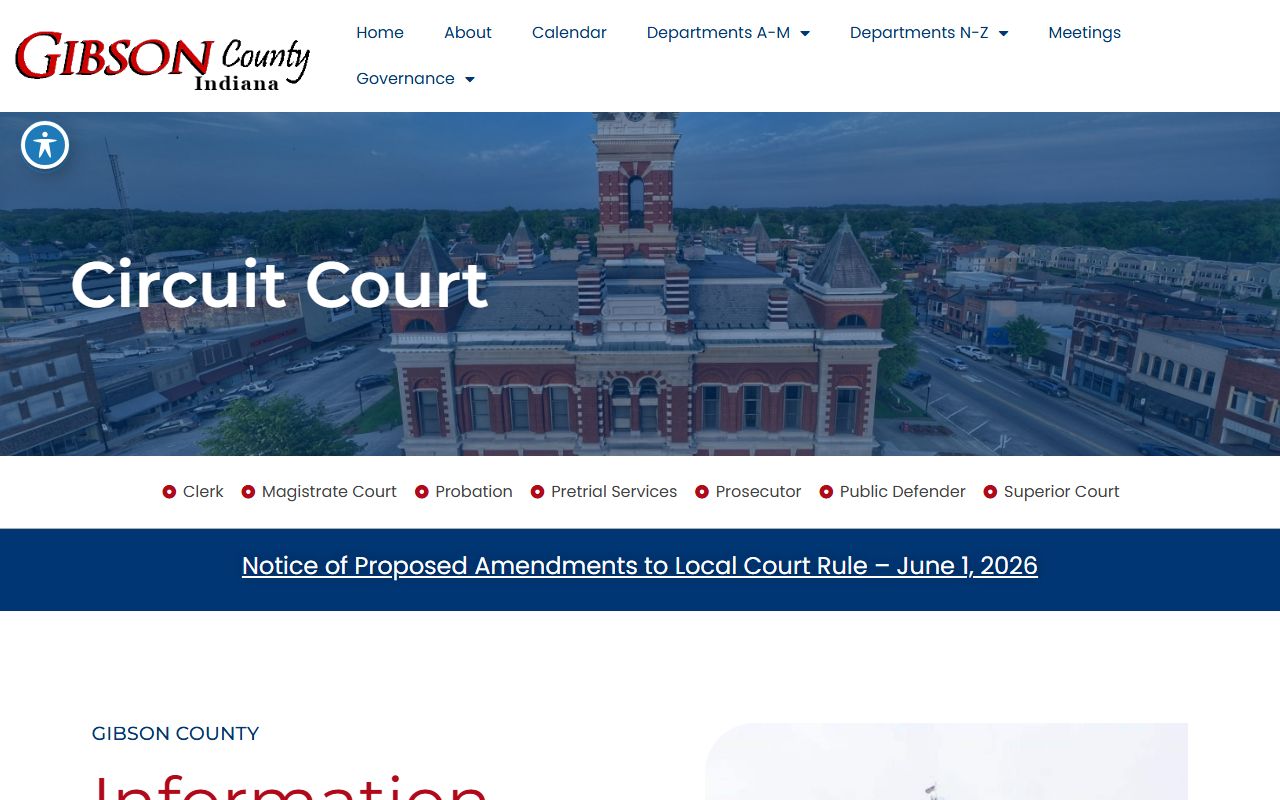
The Circuit Court source anchors the local court contact information, while the Superior Court page explains the county's jurisdictional split in more detail.
Gibson County Court List
Gibson County court work centers on the courthouse address in Princeton. The Superior Court page does not publish a separate address in the research file, so the clerk and courthouse address is the public records path unless a court order or notice gives a different location. Traffic payment mail uses the clerk suite address. Marriage ceremonies may route through the Magistrate's Office by appointment.
| Court or Office | Role | Address | Phone |
|---|---|---|---|
| Gibson Circuit Court | General trial court; court page lists judge and staff | Court House, 101 N Main St., Princeton, IN 47670 | (812) 385-4885; fax (812) 385-3089 |
| Gibson Superior Court | Jurisdictionally equal to Circuit Court; criminal division, traffic, small claims, drug court | Use courthouse/clerk address unless court posts otherwise | Clerk main number (812) 386-6474 for filings and copy path |
| Gibson Magistrate Court / Magistrate Office | Ceremonies by appointment and assigned matters under local practice | Gibson County Courthouse, 101 N Main St., Princeton, IN 47670 | (812) 386-6237 for marriage ceremony appointment |
| Gibson County Clerk of the Circuit Court | Unified clerk for filings, documents, payments, marriage, probate, support, bond, restitution, judgments | 101 N Main St., Princeton, IN 47670 | (812) 386-6474 |
| Traffic Violations Bureau / Traffic Division | Receipts traffic payments and directs users to MyCase/publicaccess | Clerk's Office, 101 N Main St., Suite 9, Princeton, IN 47670 | (812) 386-6474 |
Indiana Court Comparison
Because Indiana does not use Gibson County district courts, comparison language should match the state structure. Circuit and superior courts are county trial courts. Magistrate functions and traffic bureau work support trial court operations. City or town courts may exist where locally created, but the Gibson County research did not identify a separate city or town court page for the assigned trial-court record path.
| Feature | Circuit Court / Superior Court | Magistrate Court / Office | Traffic Violations Bureau |
|---|---|---|---|
| Core role | County trial court case handling and orders | Assigned judicial functions and courthouse ceremonies | Traffic payment and payable infraction processing |
| Criminal jurisdiction | Superior Court handles a specific criminal division; Circuit Court also receives cases under local allocation | May handle assigned appearances or matters under local practice | No independent criminal trial role in the research |
| Civil and family work | Civil, divorce, small claims, probate, eviction, and related case types appear in local rules and clerk records | Limited to assignments or ceremony function found in research | Not a general civil court |
| Records path | MyCase for public docket, clerk for copies | Clerk or court notice depending on assigned matter | MyCase/publicaccess and clerk traffic office |
The Gibson Superior Court page states that Superior Court is jurisdictionally equal to Circuit Court.
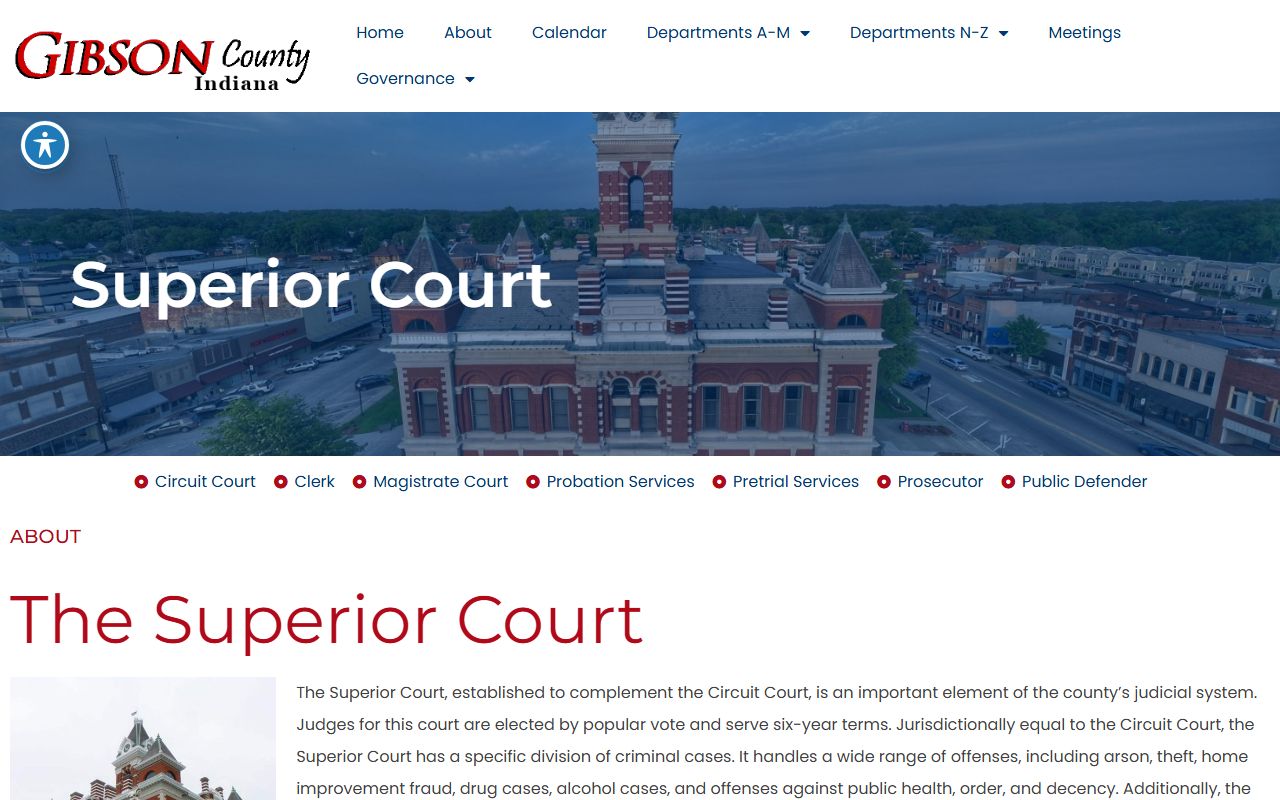
That equal-jurisdiction statement is the key reason this page treats Circuit Court and Superior Court together instead of forcing a district-court model.
Gibson County Case Flow
Case flow depends on case type, but the main record path is consistent: filings open or update a case, the court enters orders and hearing events, and the clerk maintains the official record. Criminal cases can begin with arrest, warrant, or charging information. Civil cases begin with a complaint, petition, or other initiating filing. Traffic cases may begin with a citation and may be payable online if assessed, but some infractions require a court appearance.
Criminal flow: Arrest or charge › first appearance › charging information › arraignment › pretrial hearings › plea or trial › disposition › sentencing › appeal.
Civil flow: Petition or complaint filed › service › answer or response › motions or discovery › mediation if ordered › hearing or trial › judgment › post-judgment steps › appeal.
Traffic flow: Citation issued › ticket filed into the system › payment, admission, no contest, denial, or required appearance › judgment or hearing › BMV reporting when applicable.
Civil Criminal Family Divisions
The Superior Court page gives the clearest county-specific jurisdiction paragraph. It says Superior Court was established to complement the Circuit Court and is an important element of the county judicial system. Judges for the Superior Court are elected by popular vote and serve six-year terms. The court is jurisdictionally equal to Circuit Court, but it handles a specific division of criminal cases and also processes traffic violations, small claims, and a problem-solving drug court.
The criminal division described by the county includes arson, theft, home improvement fraud, drug cases, alcohol cases, and offenses against public health, order, and decency. Civil and family records may include divorce, small claims, eviction, protection order, probate, guardianship, and miscellaneous case types depending on filing. The Clerk-Courts page is the local hub for many of those case services, including forms and payment links.
- Criminal cases can show charges, appearances, bond orders, pleas, hearings, disposition, sentencing, restitution, and warrants.
- Civil cases can show complaints, service, answers, motions, hearings, judgments, mediation, and post-judgment activity.
- Family cases can show divorce petitions, child-related filings, court dates, decrees, and orders, with confidential details restricted when required.
- Probate cases can show wills, letters, inventories, accountings, and final distributions, subject to access limits.
Local Rules and Allocation
Gibson County local rules matter because they explain how cases are assigned and how some case types move between courts. The research file notes that the official local rules PDF includes assignment and reassignment of judges in criminal cases and says all misdemeanor and felony cases are filed in the courts of record in Gibson County under an allocation approach. It also identifies Superior Court case types including DC, DN, DR, SC, CC, and EV.
Expungement petitions are also tied to court allocation. Research notes from the local rules say Indiana Code 35-38-9 petitions are filed in the court where the conviction occurred or where the case was filed if no conviction occurred. If convictions are in both Circuit and Superior Courts, the petition is filed in the court with the highest-level case. That rule is important for record searches because the correct court can depend on the original case path.
The Indiana Judicial Branch local-rules index is the state source for county local rule publications.
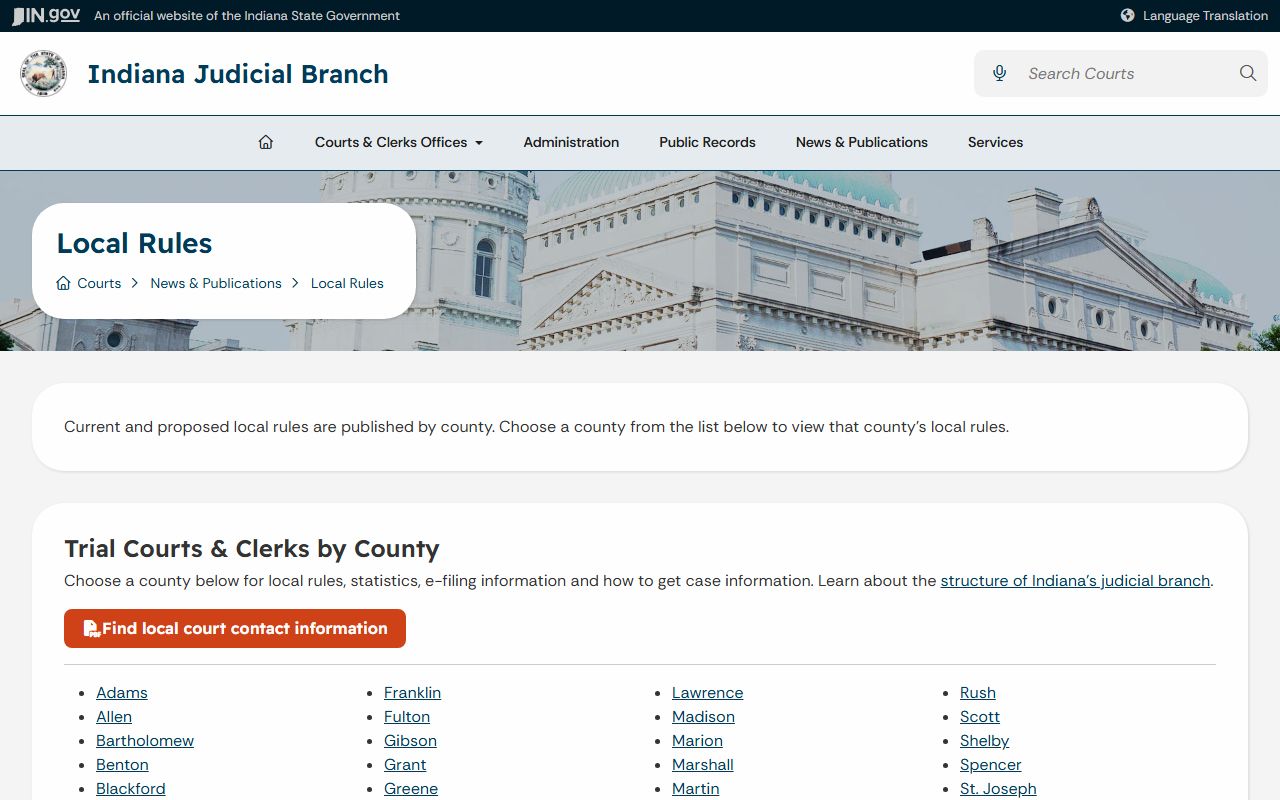
The local-rules index is the stable access point when the county PDF changes or when a user needs the current amendment set.
Search Trial Court Records
Gibson County court records are searched through Indiana MyCase for public case information. MyCase may show the case number, court, parties, filing date, case type, case status, docket entries, hearings, attorneys, financial obligations, traffic payment status, and document links when available. Some documents are not online. Indiana public-records guidance directs users to contact the clerk in the county where the case is being heard when a document cannot be accessed through the public portal.
| Search Field | Use | Gibson County Note |
|---|---|---|
| Case Number | Best when the cause number is known | Traffic page calls it a ticket or cause number. |
| Party Name | Search by person or business | Try partial names if spelling is uncertain. |
| Citation or Ticket Number | Traffic search | Useful for lost-ticket lookup. |
| County | Limits results by county | Select Gibson when available. |
| Court | Limits by court | Use Gibson Circuit Court or Gibson Superior Court if shown. |
| Case Type | Limits by category | Civil, criminal, infraction, small claims, family, probate, and similar categories may appear. |
Appeals and Federal Court
Appeals from Gibson County trial courts move into the Indiana appellate system. Most appeals go first to the Court of Appeals of Indiana, with selected matters reaching the Supreme Court of Indiana. The Indiana Tax Court is separate and handles state tax matters. A trial court record does not become an appellate record automatically for public search purposes, so users may need both trial and appellate case details if a case was appealed.
Federal matters are separate from Gibson County trial courts. Gibson County is in the U.S. District Court for the Southern District of Indiana, Evansville Division. Federal civil, criminal, bankruptcy, or federal-question litigation should not be searched as if it were a Gibson Circuit Court or Superior Court file. The county clerk remains the record route for local county trial court cases.