
Gibson County Arrest Records and Charges
Gibson County arrest records start on the law-enforcement side. They may involve the sheriff, jail, booking process, bond, warrant service, or custody status. The Gibson County Sheriff's Office and jail are at 119 E Brumfield Ave in Princeton. The sheriff site provides an inmate lookup entry and a most-wanted list for warrants issued by Gibson Circuit Court or Gibson Superior Court. Those tools are useful for current custody and warrant context, but they are not the full court charge record.
Court charges after arrest begin when the prosecutor files formal charges in court. The charge record then appears in the criminal case file maintained through Gibson Circuit Court, Gibson Superior Court, and the Clerk of the Circuit Court. For the broader case file, including pleas, hearings, disposition, and sentence, use the Gibson County criminal court records page. For current jail roster and custody details, use the local inmate lookup channels rather than assuming every arrest appears in a public court result at once.
Search Gibson County Arrest Records
Start by separating the question. If the question is whether someone is currently in custody, use the Gibson County Sheriff's inmate lookup and the jail contact route. If the question is whether court charges were filed after an arrest, search Indiana MyCase by defendant name or cause number and filter for Gibson County. If the question is whether an arrest led to a warrant, check the sheriff most-wanted source and the related MyCase docket if a case exists.
- Check the sheriff inmate lookup for current custody or recent booking context.
- Search MyCase by name or cause number to see whether formal charges were filed in court.
- Open the criminal case and read each charge, class, statute, amendment, and status entry.
- Review the disposition before saying a charge became a conviction.
- Call the Clerk of the Circuit Court or sheriff when public sources conflict or are incomplete.
The Indiana DOC offender locator is a statewide custody source related to arrest and charge records.
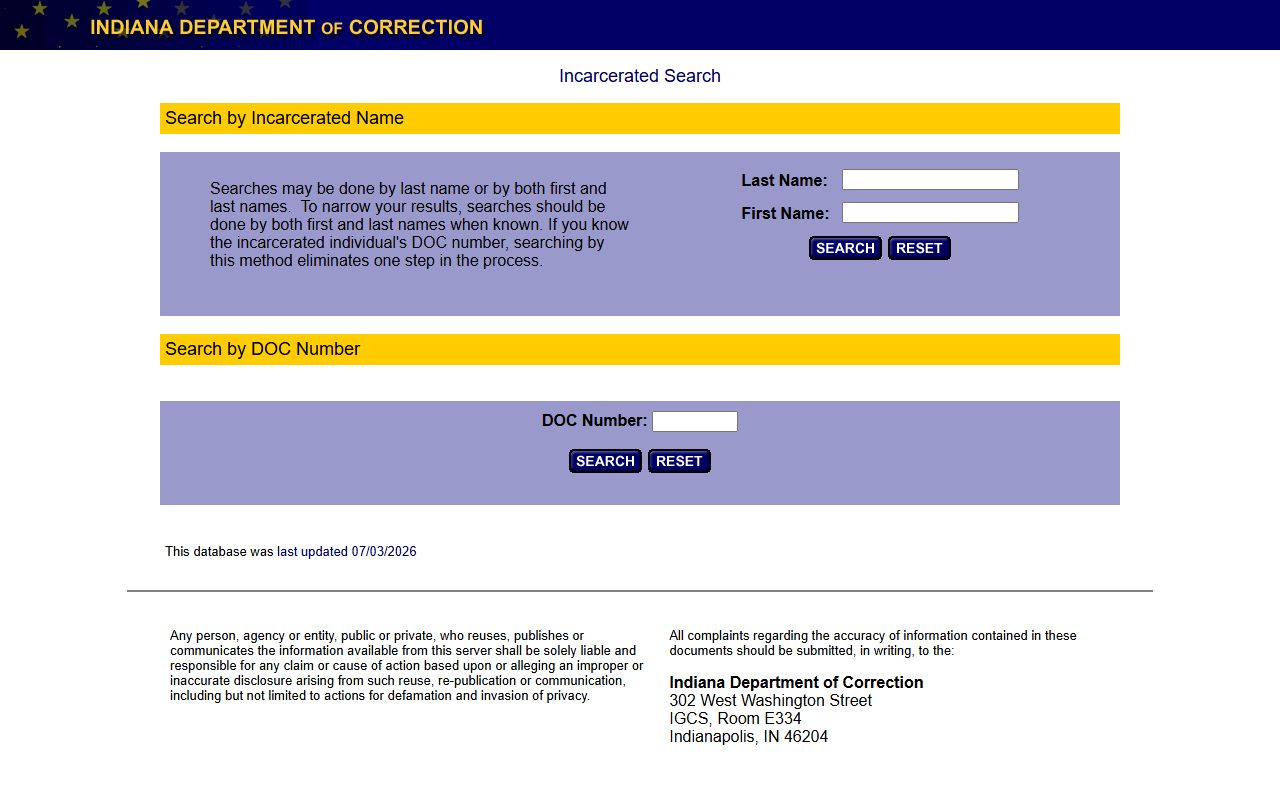
The DOC locator is a statewide sentenced-custody source, so it should not be confused with a new Gibson County arrest or fresh court charge.
Gibson County Charges Filed After Arrest
The prosecutor's decision is the key turning point between arrest and court charge record. Indiana uses the term Prosecutor, not District Attorney. Gibson County's prosecutor is Michael R. Cochren, and the prosecutor office matters because it decides how to proceed after law enforcement reports an arrest or alleged offense. The Clerk of the Circuit Court then maintains the filed court record once the charge enters the case system.
| Document | Filed By | Common Use | What It Starts |
|---|---|---|---|
| Complaint | Officer or prosecutor | Used to begin many criminal or infraction matters. | A court case or charge entry. |
| Information | Prosecutor | Common charging document for many Indiana criminal cases. | Formal prosecution in court. |
| Indictment | Grand jury | Used when a grand jury returns charges. | A criminal case based on the indictment. |
Gibson County Charge Status
Charge status can change. A filed charge may be pending at first, then amended, reduced, dismissed, or resolved by plea or trial. One case can contain several counts with different results. A person may also have a charge filed in one court, an expungement petition later, and a public access change after the court signs an order. Reading the most recent docket entries prevents a stale or incomplete description.
| Status | What It Means |
|---|---|
| Pending | The charge is filed and has not reached final disposition. |
| Amended | The prosecutor or court record changed the charge wording, level, statute, or count details. |
| Reduced | The charge moved to a lower level or different offense, often through plea or amendment. |
| Dismissed | The court or prosecutor ended that count without a conviction on that charge. |
| Convicted | The court entered a guilty result by plea, verdict, or judgment. |
| Expungement Filed | A later petition asks the court to restrict public access under Indiana law. |
Gibson County Charges vs Convictions
A charge is an accusation filed in court. A conviction is a final guilty result. The difference is essential for Gibson County arrest records because an arrest may lead to no filed charge, one filed charge, several filed charges, a reduced plea, a dismissal, or a conviction. Court charges after arrest should be described as pending unless the court record shows a disposition.
| Point | Charge | Conviction |
|---|---|---|
| Stage | Filed after arrest or investigation. | Entered after plea, verdict, or judgment. |
| Meaning | The state alleges an offense. | The court records guilt for that count. |
| Can Change | Yes, it may be amended, reduced, or dismissed. | Yes, later appeal, correction, or expungement may affect access. |
| How to Verify | Read the charging entry and docket. | Read disposition and sentencing entries. |
Gibson County Prosecutor Charge Decisions
The prosecutor also controls some non-custody outcomes. Gibson County traffic instructions say people interested in the Infraction Deferral Program should refer to the Prosecutor's page or call (812) 385-5497 to see if they qualify. Paying a traffic ticket before court can end eligibility for deferral and cancel the court date. That same idea applies broadly: a payment, plea, deferral, dismissal, or amendment can change the charge record even when the arrest fact remains separate.
Prosecutor decisions can appear in the court record as amended charges, plea agreements, dismissals, diversion or deferral activity, sentencing recommendations, or restitution requests. The public record may not explain every negotiation behind the entry. It shows what was filed and what the court accepted or ordered.
Gibson County Bond After Arrest
Arrest-to-charge records often include bond and hearing timing. The jail page says inmates can be bonded out 24/7 in the jail lobby, with exact-change cash or credit card surcharges. Online GovPay bond payments are capped at $2,500. If there is no arrest warrant, the ordinary bond schedule applies unless modified by the Superior or Circuit Court judge. If an arrest warrant exists, the bond listed on the warrant controls.
Initial hearing or arraignment entries should be read with the charge list. A bond entry alone does not prove the final charge or outcome. A missed hearing may lead to a bench warrant, failure-to-appear entry, or license consequence in traffic matters. The sheriff, court, and clerk each hold part of the path, so the safest reading uses all three official channels.
Statewide Arrest and Custody Sources
Statewide sources are useful after the county stage. The Indiana Department of Correction locator is for people in state correctional custody after the local jail and court process. Indiana SAVIN can be used for custody-status lookup and notifications, and research says it can search by partial or complete offender last name, offender ID, or offender case number. These systems do not replace Gibson County court charges in MyCase or sheriff custody data.
Indiana SAVIN offender search is another statewide custody and notification source related to Gibson County arrest records and charges.
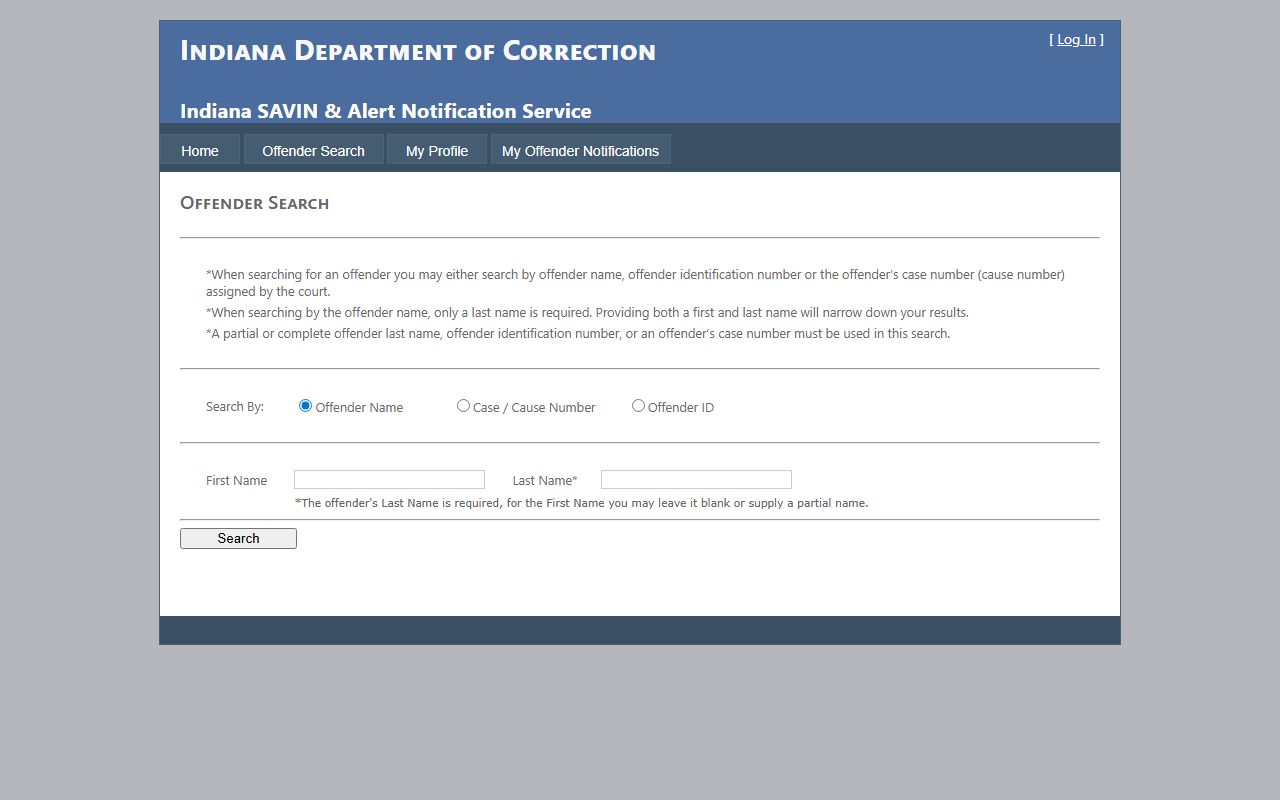
SAVIN helps with custody notification, while the filed court charge remains a court record maintained through the Gibson County trial courts.
Gibson County Charge Codes
Gibson County charge records may show statutes, classes, case type codes, and count numbers. The local research references criminal case type routing and codes such as DC, DN, DR, SC, CC, EV, XP, MI, and MC across court records. Criminal charges should be read at the count level because one case can include a felony count, misdemeanor count, infraction, dismissal, or later expungement petition. A statute or class explains what was alleged, not whether the person was convicted.
- Cause number
- The Indiana case number used to identify the court file.
- Count
- A separate charge within one criminal case.
- Disposition
- The result for a case or count, such as conviction, dismissal, or judgment.
- Bond
- Money or surety used to secure release and court appearance.
- Expungement
- The Indiana process that can restrict public access to qualifying arrest or conviction records.
Sealed and Expunged Charges
Indiana access rules and expungement law can limit public access to arrest and charge records. Gibson County local-rule research says expungement petitions under IC 35-38-9 are filed in the court where the conviction occurred or where the case was filed if there was no conviction. If both Circuit and Superior Courts are involved, the highest-level case controls. If an arrest produced no charges, the petition goes to the court that would have handled the most serious unfiled charge.
| Point | Sealed | Expunged |
|---|---|---|
| Public Visibility | Hidden or limited by court order, rule, or law. | Restricted after the court grants relief under Indiana expungement law. |
| Applies To | Confidential cases, documents, or protected information. | Qualifying arrest and conviction records. |
| Effect on Search | Entry or document may not appear to the public. | Public display changes after the order. |
| Still Accessible To | Court or law enforcement where law allows. | Court or law enforcement where law allows. |
Restricted Gibson Arrest Records
Juvenile arrest and charge records have separate confidentiality rules. Indiana juvenile records are governed by IC 31-39 and should not be handled like adult criminal records. Adoption, mental health, confidential contact information, protected victim data, Social Security numbers, sealed cases, and expunged records may be excluded or redacted under Indiana court access rules and related statutes. A public search should not promise mugshots, every booking detail, or a complete criminal history.
The Indiana juvenile records statute chapter explains why juvenile arrest and charge records have different access rules.
Juvenile restrictions are a core reason that some arrest or charge records cannot be found through ordinary public lookup tools.
Important: Public charge lookup is not an employment, tenant, credit, insurance, or other FCRA consumer report.